Afternoon Slump: Is Lunch Really to Blame?

The afternoon slump is real, and lunch is only part of the story. In laboratory studies, alertness and performance dip in the early afternoon whether or not people have eaten, and the researchers who measure it describe it as a feature of the body clock, not a verdict on your sandwich. Lunch does matter: a heavy meal deepens the dip, and a short night makes it deeper still. This article separates the three things stacked on top of each other at 2 PM — the clock, the meal and your sleep — and walks through what the studies say actually helps. It also covers where daily focus support from a citicoline supplement fits, and where it does not.
In this article: The dip that shows up with an identical lunch · What lunch adds on top · Carbs, fat or protein? The evidence is mixed · Sleep debt makes the dip deeper · What the studies say actually helps · A plan for the 2 PM hour · Where Great Billiom Citicoline fits

The dip that shows up with an identical lunch
The clearest statement of what the afternoon slump is comes from a 2015 study in PLOS ONE by Slama and colleagues at the Université Libre de Bruxelles: "The temporary drop in alertness and performance during the afternoon, referred to as the post-lunch dip, was evidenced in laboratory studies using various cognitive tests. The post-lunch dip is not completely explained by meal ingestion, but rather reflects the 12-hour harmonic of the circadian clock."
That last phrase is the key. Your main sleep drive runs on a roughly 24-hour cycle, but a second, weaker rhythm rides on top of it and peaks twice a day — once in the early hours of the night, and once about twelve hours later, in the early afternoon. A 2021 paper in Frontiers in Psychology by Romdhani and colleagues, drawing on the sleep-research literature (Monk 2005; Bes et al. 2009), describes the post-lunch dip as "an endogenous increase of sleepiness" — endogenous meaning it comes from inside you, on a schedule, rather than from the plate.
The Slama study's design makes the point. Twenty-five well-rested adults took a task-switching test in the morning, after lunch, and in the late afternoon, and everyone ate "an identical portion of lasagna in all study conditions." With the meal held constant, performance still got worse after lunch in the control groups, with the accuracy cost of switching tasks rising by 2.41 percent. The dip arrived anyway.
As the Sleep Foundation puts it, "The circadian signals that promote wakefulness tend to decrease in the early afternoon, which can lead to sleepiness following lunch." Lunch is the thing you remember doing before you felt tired. It is not necessarily the thing that made you tired.
What lunch adds on top
None of this means the meal is innocent. A 2012 study in Physiology & Behavior by Reyner and colleagues at Loughborough University tested meal size directly. Twelve young men drove for two hours in a simulator in the early afternoon after either a light lunch of 305 calories or a heavy lunch of 922 calories, with three times the fat and twice the carbohydrate, while the researchers tracked lane drifting, rated sleepiness and the EEG. The verdict: "The heavy lunch caused significant increases to both incidents and EEG power." The gap opened about 30 minutes into the drive. One caveat belongs in the same sentence: the drivers had been restricted to five hours in bed the night before, which is exactly the condition in which a heavy lunch does the most damage.
An older study makes a related point. In 1997, Orr and colleagues gave ten healthy men either a solid test meal or an equivalent volume of water in the early evening and measured how fast they fell asleep afterward. Their finding, in Physiology & Behavior: "a solid meal produces a decrease in sleep onset latency when compared to an equivalent volume of water." The meal does shift you toward sleep — it simply adds to a dip that was coming regardless. Or, as the Cleveland Clinic's dietitian Julia Zumpano puts it, "if you're eating a heavier meal or a bigger meal, you're more likely to feel sluggish."
Carbs, fat or protein? The evidence is mixed
Ask the internet what to eat for lunch and you will be told, with confidence, to cut the carbohydrates. The research is less confident than the internet.
The Sleep Foundation states that "a high-carbohydrate meal is more likely to cause you to feel sleepy than a low-carbohydrate meal," and that "meals with foods that are high in fat can induce feelings of fatigue." That is the familiar version.
When researchers measured sleepiness objectively, the carbohydrate story did not hold up cleanly. In the Orr study, high-fat, high-carbohydrate and mixed solid meals were compared head to head, and the authors concluded that "meal constituents have no effect on postprandial sleepiness" — the meal mattered, its composition did not. And in a 2013 sleep-laboratory study of 31 healthy, non-obese adults reported by the American Academy of Sleep Medicine, Alexandros Vgontzas of Penn State and colleagues found the opposite of the popular advice: "higher fat consumption was associated with increased objective daytime sleepiness, while higher carbohydrate intake was associated with increased alertness," with "no relationship between protein consumption and sleepiness or alertness." That was a conference abstract, so it carries less weight than a published trial — but it is objective data, and it does not say what the lunch blogs say.
The honest summary: meal size has better evidence than meal composition. If you change one thing about lunch, make it lighter before you make it low-carb.
Sleep debt makes the dip deeper
The third layer is the one most people skip. The Sleep Foundation explains it through sleep pressure: "The longer you've been awake, the more your desire to sleep...grows. Thus, you're more likely to feel drowsy following an afternoon or evening meal than after breakfast." By 2 PM you have been awake for six or seven hours, the circadian dip is arriving, and if last night was short, the pressure behind it is higher than it should be.
This is why the Reyner drivers were restricted to five hours of sleep: the researchers wanted the dip at its worst, to see whether lunch could make it worse still. It could.
What the studies say actually helps
The countermeasures tested in controlled conditions are short, and none of them is a second coffee.
A short nap. In the Slama study, a 30-minute nap opportunity — in which people slept about 13 minutes on average — reversed the post-lunch rise in task-switching cost, turning a 2.41 percent worsening into a 2.13 percent improvement. In the Romdhani study of 23 trained athletes, a 20-minute nap shortened two-choice reaction time after both a normal night and a short one (after a normal night, from 418 to 375 milliseconds), and after a normal night the nap was the only intervention that reduced sleepiness and improved mood.
Bright light. In the same Slama study, 30 minutes under bright blue light of about 2,000 lux, compared with dim orange placebo light, produced the same post-lunch improvement as the nap. The Cleveland Clinic lists bright light at the desk among its suggestions.
A walk. No trial has randomized office workers to a post-lunch walk, so this rests on expert guidance: the Cleveland Clinic recommends a 10–15 minute walk after meals. Our article on what 24 trials show about circulation while sitting covers why a few minutes of leg movement does more for a long desk sit than standing up alone.
A lighter lunch. The Reyner result is the direct evidence: 305 calories versus 922 produced measurably fewer lane drifts and less sleepiness on the EEG.
Caffeine, carefully. In the Romdhani study, caffeine at 5 mg per kilogram shortened simple reaction time whether or not people had slept well, but after a normal night it did not reduce sleepiness or improve mood the way the nap did; the authors concluded this "suggests a different mode of action of napping and caffeine." The Cleveland Clinic's advice is to limit caffeine and sip it gradually; the Sleep Foundation's is to keep it at least eight hours from bedtime.
What was tested | Study | Finding |
30-minute nap opportunity vs staying awake, well-rested adults | Slama 2015, n=15 | Post-lunch switch-cost went from +2.41% (awake) to −2.13% (nap) |
30 minutes of bright blue light (~2,000 lux) vs dim orange light | Slama 2015, n=10 | Same post-lunch improvement as the nap |
20-minute nap vs caffeine (5 mg/kg) vs both, trained athletes | Romdhani 2021, n=23 | Nap shortened choice reaction time after short and normal nights; after a normal night only the nap reduced sleepiness |
Light (305 kcal) vs heavy (922 kcal) lunch, 2-hour afternoon drive after 5 h sleep | Reyner 2012, n=12 | Heavy lunch increased lane drifts and EEG sleepiness markers from about 30 minutes in |
Solid meal vs water; high-fat vs high-carb vs mixed | Orr 1997, n=10 | Any solid meal shortened time to fall asleep; composition made no difference |
A plan for the 2 PM hour
Built from the studies above, in the order the evidence supports:
Expect the dip, and schedule around it. It arrives on a clock, with or without lunch. Put the work that needs the least judgment in the early afternoon.
Eat a lighter lunch rather than a different lunch. Meal size has direct trial evidence; the carbohydrate-versus-fat question does not.
If you can nap, nap for 20 to 30 minutes, not longer. The benefit in the studies came from a few minutes of light sleep.
If you cannot nap, get bright light. Thirty minutes at a bright window did as much as a nap in the Slama study.
Walk after you eat. Ten to fifteen minutes is the clinic guidance.
Protect last night's sleep more than today's coffee. Sleep pressure sets the depth of the dip, and caffeine did not reduce sleepiness after a normal night in the trial that compared it with a nap.
Where Great Billiom Citicoline fits
Everything above is about the afternoon itself: the clock, the meal, the light, the walk. Citicoline belongs to a different part of the picture. It is not a nap and it is not a stimulant; it is a daily practice that supplies choline, which the NIH Office of Dietary Supplements describes as "needed to produce acetylcholine, an important neurotransmitter for memory, mood, muscle control, and other brain and nervous system functions." The NIH sets the Adequate Intake at 550 mg a day for adult men and 425 mg for adult women and reports average intake from food at 402 mg and 278 mg — so most adults are below the mark before the afternoon begins. Our guide to supplements for memory and focus walks through the randomized citicoline trials in healthy adults, and our comparison of citicoline vs alpha-GPC explains how the two choline sources differ. One limit to state plainly: none of those trials measured afternoon performance in particular, so this article makes no claim about the 2 PM hour on citicoline's behalf.
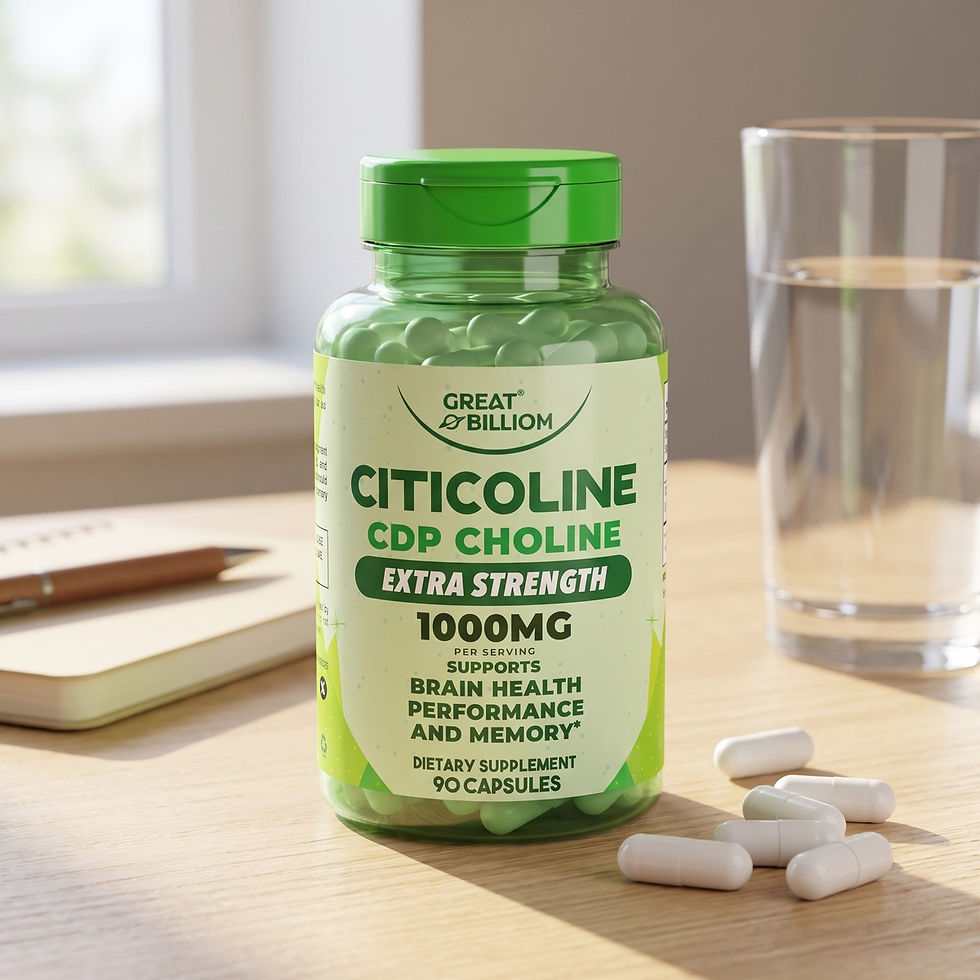
What we can tell you is what is in the bottle. Great Billiom Citicoline CDP Choline provides 500 mg of citicoline per capsule and 1,000 mg per two-capsule serving, and it supports memory, focus and mental clarity with clean mental energy without caffeine or sugar — a meaningful distinction for anyone who has noticed that the second coffee shortens the night and deepens tomorrow's dip. The label directions are two capsules daily with 8 to 12 ounces of water, preferably in the morning, which puts the serving ahead of the afternoon rather than in it. A bottle holds 90 capsules, a 45-day supply, for $19.99, or $17.99 on Subscribe & Save. If you are pregnant or nursing, take prescription medication, or manage a medical condition, talk to your doctor before starting it.
Key takeaways
The afternoon slump is a circadian feature, not just a lunch effect: in a study where everyone ate an identical lunch, task-switching performance still dipped afterward (Slama 2015).
Lunch deepens the dip rather than causing it. A 922-calorie lunch produced more lane drifting and more EEG sleepiness than a 305-calorie one in a two-hour afternoon drive (Reyner 2012), and any solid meal shortened time-to-sleep compared with water (Orr 1997).
The carbohydrate-versus-fat question is unsettled: one study found composition made no difference, and one found fat, not carbohydrate, tracked with objective sleepiness.
A short night sets the depth of the dip, because sleep pressure and the circadian low arrive together in the early afternoon.
The tested countermeasures are a 20–30 minute nap, 30 minutes of bright light, a lighter lunch and a walk; caffeine sharpened reaction time but did not reduce sleepiness after a normal night.
A lighter lunch, a bright window and twenty minutes of light sleep: that is what the afternoon studies support, and it works the same day. If you also want daily support for focus and mental clarity across the working week without adding caffeine to it, Great Billiom Citicoline CDP Choline gives you 1,000 mg of citicoline per two-capsule serving, taken in the morning, for $19.99.
Frequently asked questions
Why do I get tired after lunch?
Three things arrive together. Your body clock has a second, lower low point about twelve hours after the night-time one, which lands in the early afternoon whether or not you ate. Sleep pressure has been building since you woke. And a meal, especially a large one, shifts you further toward sleepiness. Lunch is the part you notice; the dip itself is circadian.
What time is the post-lunch dip?
The early afternoon. Sleep researchers describe it as the 12-hour harmonic of the circadian clock, the daytime echo of the night-time low. In the laboratory studies it was measured about seven to eight hours after waking — for someone up at 7 AM, roughly 2 to 3 PM. The exact time shifts with when you wake and how much sleep you got.
Does skipping lunch stop the afternoon slump?
No. In a 2015 study where every participant ate the same lunch, performance still dipped afterward, and the authors concluded the dip "is not completely explained by meal ingestion." Skipping lunch removes the meal's contribution but leaves the circadian dip and your sleep debt untouched. A lighter lunch, not a missed one, is what the meal-size evidence supports.
Is it carbs that make you sleepy after eating?
The evidence is mixed. One controlled study compared high-fat, high-carbohydrate and mixed meals and found "meal constituents have no effect on postprandial sleepiness." A sleep-laboratory study of 31 adults found higher fat intake tracked with more objective sleepiness and higher carbohydrate intake with more alertness. Meal size has clearer evidence than meal composition.
Does citicoline help with the afternoon slump?
No citicoline trial has measured afternoon performance specifically, so this article makes no claim about it. Citicoline supplies choline, the raw material for acetylcholine, and Great Billiom Citicoline supports memory, focus and mental clarity with clean mental energy without caffeine or sugar, taken as the label directs: two capsules in the morning. For the afternoon itself, the studied countermeasures are a nap, bright light and a lighter lunch.
Megan Elliott, Content Editor at Great Billiom. Every claim in this article is sourced from the primary research linked above. Read our editorial standards → thegreatbilliom.com/editorial-standards
Sources
Slama H, Deliens G, Schmitz R, Peigneux P, Leproult R. "Afternoon Nap and Bright Light Exposure Improve Cognitive Flexibility Post Lunch." PLOS ONE, 2015;10(5):e0125359.
Reyner LA, Wells SJ, Mortlock V, Horne JA. "'Post-lunch' sleepiness during prolonged, monotonous driving — Effects of meal size." Physiology & Behavior, 2012;105(4):1088–1091.
Orr WC, Shadid G, Harnish MJ, Elsenbruch S. "Meal Composition and Its Effect on Postprandial Sleepiness." Physiology & Behavior, 1997;62(4):709–712.
American Academy of Sleep Medicine. "Study links diet with daytime sleepiness and alertness in healthy adults" (Vgontzas A et al., abstract presented at SLEEP 2013). News release, May 7, 2013.
Romdhani M, Souissi N, Dergaa I, et al. "The effect of experimental recuperative and appetitive post-lunch nap opportunities, with or without caffeine, on mood and reaction time in highly trained athletes." Frontiers in Psychology, 2021;12:720493.
Cleveland Clinic Health Essentials. "Tired After Eating? Here's Why." May 20, 2022.
Bryan L; reviewed by Guo L. "Why You Get Sleepy After Eating." Sleep Foundation, updated October 28, 2025.
NIH Office of Dietary Supplements. "Choline: Fact Sheet for Health Professionals." Updated June 2, 2022.
These statements have not been evaluated by the Food and Drug Administration. This product is not intended to diagnose, treat, cure, or prevent any disease. Individual results may vary.


Comments