Supplements for Memory and Focus: Citicoline

Updated: 24 hours ago
Search for supplements for memory and focus and you get the same page a hundred times: a dozen ingredients, a sentence each, and a buy button. This guide does the opposite. It takes one ingredient, citicoline (also sold as CDP-choline), and walks through the randomized trials in healthy people we could verify: what they measured, what they found, and where the evidence stops. The short version is that three trials found improvements on some memory and attention measures at 250 to 500 mg a day. They were short, they enrolled 60 to 100 people each, the ingredient's manufacturer funded or supplied at least two of them, and a European regulator concluded in 2024 that the memory evidence does not establish cause and effect. Our own Citicoline CDP Choline is the ingredient this guide is about, so we have every reason to show you both halves.
In this article: Why this guide covers one ingredient, not twelve · What the memory trial found, and what it did not · What the focus trials found · Where the evidence stops · Dose, timing and safety · How to read a memory and focus supplement label · Where Great Billiom Citicoline fits
Why this guide covers one ingredient, not twelve
A multi-ingredient "memory and focus" blend is hard to judge for a plain reason: the research on these ingredients mostly tested one compound at a time, at a stated dose. If a label lists eight ingredients inside a proprietary blend, there is no way to match any of them to a trial. So we went deep on one.
Citicoline is a sensible place to start because its role in the body is well described. The Alzheimer's Drug Discovery Foundation, a nonprofit research reviewer, calls it "a naturally occurring compound that serves as a precursor for essential cellular nutrients," choline among them. Choline, in the words of the NIH Office of Dietary Supplements, "is needed to produce acetylcholine, an important neurotransmitter for memory, mood, muscle control." The NIH sets the Adequate Intake at 550 mg a day for adult men and 425 mg for adult women, and reports average intake from food at 402 mg and 278 mg. Most adults eat less than the target.
Citicoline's full chemical name is cytidine 5'-diphosphocholine. The Alzheimer's Drug Discovery Foundation notes that it is a precursor for both choline, "which is used in the production of cell membranes," and acetylcholine. Your body makes some choline on its own, but not enough. In the NIH's words, "Humans can produce choline endogenously in the liver, mostly as phosphatidylcholine, but the amount that the body naturally synthesizes is not sufficient to meet human needs." That makes food the main source: the NIH's list of top sources includes beef liver, eggs, beef, soybeans, chicken, cod and potatoes, with lower amounts in vegetables such as broccoli.
None of that shows that a supplement changes how well you remember or concentrate. That is what trials are for. If you are weighing citicoline against another choline source, our citicoline vs alpha-GPC comparison covers that question on its own.
What the memory trial found, and what it did not
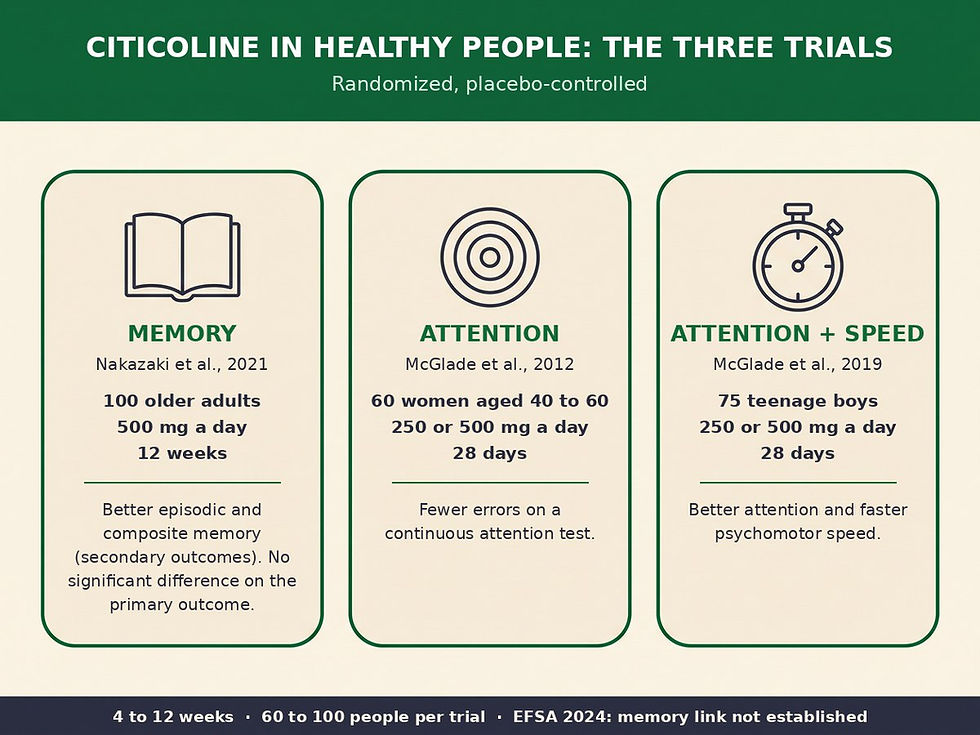
The trial cited most often for citicoline and memory is Nakazaki and colleagues, published in The Journal of Nutrition in 2021. It enrolled 100 healthy older adults with age-associated memory impairment and gave them 500 mg of citicoline or a placebo every day for 12 weeks, double-blind.
The result that gets quoted: episodic memory, measured with a paired-associate test, improved more with citicoline than with placebo (a mean change of 0.15 against 0.06), and a composite memory score improved by 3.78 against 0.72.
The result that rarely gets quoted: those were secondary outcomes. The trial's primary outcome, a spatial-span memory test, did not differ significantly between the groups. The study was sponsored by the ingredient's manufacturer, which also took part in designing it, and several of the authors were that company's employees. The authors themselves write that the findings "may not be generalizable to young adults."
That does not make the trial worthless. A randomized, placebo-controlled design is a real strength. It does mean one positive result on secondary measures, in one population, is a starting point rather than a settled answer.
What the focus trials found
In research, "focus" usually means attention: catching the right signal, ignoring the wrong one, and keeping it up. Two randomized trials from the same research group tested citicoline on attention.
Study | Who took part | Daily dose | Length | What differed from placebo | Limits worth knowing |
McGlade et al., 2012 | 60 healthy women aged 40 to 60 | 250 or 500 mg | 28 days | Fewer commission errors at both doses; fewer omission errors at 250 mg | Women only; supplement supplied by the ingredient maker |
McGlade et al., 2019 | 75 healthy adolescent males | 250 or 500 mg | 28 days | Better attention and faster psychomotor speed | Teenagers only; four weeks |
Nakazaki et al., 2021 | 100 healthy older adults with age-associated memory impairment | 500 mg | 12 weeks | Episodic and composite memory (secondary outcomes) | Primary outcome did not change; sponsored by the ingredient maker |
In the 2012 trial, women taking 250 mg made fewer omission errors (missed targets, p = 0.04) and fewer commission errors (responses to the wrong target, p = 0.03) on a continuous performance test. The 500 mg group made fewer commission errors (p = 0.03). The authors keep their conclusion narrow: citicoline "may improve attentional performance in middle-aged women."
The 2019 trial reported better attention (p = 0.02) and faster psychomotor speed (p = 0.03) after 28 days. It studied teenage boys, which says little about a 45-year-old at a desk, and it is not a reason to give teenagers supplements. We include it because it is part of the published attention evidence, and leaving it out would make the record look tidier than it is.
Where the evidence stops
In July 2024, the European Food Safety Authority's nutrition panel reviewed a proposed health claim for citicoline and memory. Its conclusion: "a cause-and-effect relationship has not been established between the consumption of citicoline (CDP-Choline) inner salt and improvement, maintenance or reduced loss of memory in middle-aged or elderly adults encountering age-associated subjective memory impairment." Its reasoning was that "only one randomised controlled trial in healthy participants showed a beneficial effect of citicoline on episodic memory when consumed at doses of 500 mg/day for 12 weeks, whereas this effect has not been observed in another study using citicoline at doses of 1 g/day for 3 months."
The Alzheimer's Drug Discovery Foundation lands in a similar place: citicoline "has shown benefits in individuals with lower cognition at the beginning of studies, but due to discrepancies across studies, there is insufficient evidence that it is beneficial in healthy people with otherwise good cognition." A 2026 systematic review of 16 studies in older adults and people with cognitive impairment found measurable changes in memory, attention and executive function in several of them, while noting that "the results lack consistency across studies" and calling for "larger-scale, double-blind, and methodologically robust randomized controlled trials."
Put plainly, the limits are these:
Size. 60 to 100 people per trial.
Length. Four to 12 weeks. No trial here followed healthy people for longer.
Funding. All three trials tested one manufacturer's citicoline. In the two whose disclosures we could read, that company funded or supplied the study and employed some of the authors.
Outcomes. The memory result came from secondary measures, and the attention results came from specific computer tasks rather than everyday life.
People. Older adults with age-associated memory impairment, women aged 40 to 60, and teenage boys. Possibly not you.
That is an early evidence base, not an absent one. It is also exactly as far as the research goes today.
Dose, timing and safety
Dose. The trials in healthy people used 250 or 500 mg a day. The Alzheimer's Drug Discovery Foundation gives typical doses as 250 to 1,000 mg a day and notes that in healthy people "lower doses (e.g. 250 mg/day) may provide more benefit than higher doses." More is not automatically better.
Timing. The trials compared citicoline with placebo, not one time of day with another, so timing comes down to label directions. Our label directions are two capsules daily, preferably in the morning, with 8 to 12 ounces of water. If the reason you are reading is the energy dip after lunch, our article on the afternoon slump separates what the body clock, the meal and your sleep each contribute.
Safety. The Alzheimer's Drug Discovery Foundation reports that "no serious safety issues have been reported," and notes that citicoline "may interact with Parkinson's drugs such as levodopa." The NIH sets a Tolerable Upper Intake Level for choline from all sources of 3,500 mg a day for adults. If you are pregnant or breastfeeding, take prescription medication, or manage a medical condition, talk to your doctor before starting any supplement.
How to read a memory and focus supplement label
The form, by name. "Citicoline" or "CDP-choline" is the compound the trials above used. A label that says only "choline" or "brain blend" is describing something else.
Milligrams per serving and per capsule. Compare the serving with the 250 to 500 mg the healthy-adult trials used. If two capsules make a serving, do the math before you compare.
No proprietary blend hiding the dose. If the amount of each ingredient is not stated, it cannot be compared with any study.
Caffeine and other stimulants. Many focus products include them. They are not what the citicoline trials tested, and they make it hard to tell which ingredient is doing what.
Evidence of quality testing. A brand that names its manufacturing standard or its independent lab testing gives you something you can check. A label that mentions neither asks you to take the dose on trust.
Claims that match the evidence. "Supports memory and focus" is structure/function language. Promises of a specific result, or claims about a medical condition, are a red flag.
Where Great Billiom Citicoline fits

The trials above tested one manufacturer's citicoline, at specific doses, in specific people. Their results describe those trials. They are not a claim about what any particular product will do for you, ours included.
What we can tell you is what is in the bottle. Great Billiom Citicoline CDP Choline is the CDP-choline form this guide describes. Each capsule is 500 mg, the daily amount used in the 2021 memory trial and in the higher-dose group of both attention trials. The label serving is two capsules, 1,000 mg, which sits inside the 250 to 1,000 mg range the Alzheimer's Drug Discovery Foundation describes as typical. A bottle holds 90 capsules, a 45-day supply at the label serving, for $19.99, or $17.99 with Subscribe & Save, which works out to $0.44 per serving. It supports memory, focus and mental clarity, and it gives clean mental energy without caffeine or sugar.* Follow the label, and ask your doctor before changing the amount.
Key takeaways
Most lists of supplements for memory and focus skip the trials. For citicoline, three randomized trials in healthy people exist, at 250 to 500 mg a day for four to 12 weeks.
The 2021 memory trial found better episodic and composite memory scores, but on secondary outcomes. Its primary outcome did not change.
Two attention trials found fewer errors or better attention scores after 28 days, in middle-aged women and in teenage boys.
EFSA concluded in 2024 that a cause-and-effect link with memory has not been established. The trials were short and limited in size, and the ingredient's manufacturer funded or supplied at least two of them.
On any label, look for the named form, the dose per serving, no proprietary blend and no hidden stimulants.
If citicoline is the ingredient you want to try, ours is 500 mg per capsule and 1,000 mg per two-capsule serving, 90 capsules for $19.99. If this guide has left you weighing it rather than sold on it, that is a reasonable place to be. The research is still being written.
Frequently asked questions
Has citicoline been tested for both memory and focus?
Yes, in separate trials. A 2021 randomized trial in 100 older adults measured memory, and randomized trials published in 2012 and 2019 measured attention, all at 250 to 500 mg a day. Each found improvements on some measures. In 2024, EFSA concluded that the memory evidence does not establish cause and effect.
How long did the citicoline trials last?
Four to 12 weeks. The two attention trials ran for 28 days and the memory trial for 12 weeks. None of the three followed people for longer, so these trials cannot tell you what happens over months or years of use in healthy adults.
How much citicoline did the studies use?
The trials in healthy people used 250 or 500 mg a day. The Alzheimer's Drug Discovery Foundation describes typical doses as 250 to 1,000 mg a day and notes that, in healthy people, lower doses may provide more benefit than higher ones. Our label serving is two 500 mg capsules, 1,000 mg in total.
Does Great Billiom Citicoline contain caffeine?
No. Each capsule provides 500 mg of citicoline (CDP-choline), and the formula contains no caffeine or sugar. That matters when you read the research, because the trials in this guide compared citicoline with a placebo, not citicoline mixed with stimulants, so a caffeinated blend is not what they tested.
Is choline the same as vitamin B12?
No. They are different nutrients with different jobs. The NIH describes choline as "an essential nutrient" that the body uses to make acetylcholine and the phospholipids in cell membranes. Vitamin B12 is "a water-soluble vitamin" that the body needs for nervous system function, healthy red blood cell formation and DNA synthesis, and it occurs naturally in foods of animal origin. Citicoline supplies choline, not vitamin B12.
Can I take citicoline with medication?
Ask your doctor first. The Alzheimer's Drug Discovery Foundation notes that citicoline may interact with Parkinson's drugs such as levodopa, and says its list is not a complete safety review. Anyone pregnant, breastfeeding, taking prescription medication or managing a medical condition should get medical advice before starting any supplement.
Megan Elliott, Content Editor at Great Billiom. Every claim in this article is sourced from the primary research linked above. Read our editorial standards → thegreatbilliom.com/editorial-standards
Sources
Nakazaki E, Mah E, Sanoshy K, Citrolo D, Watanabe F. "Citicoline and Memory Function in Healthy Older Adults: A Randomized, Double-Blind, Placebo-Controlled Clinical Trial." The Journal of Nutrition, 2021;151(8):2153–2160.
McGlade E, Locatelli A, Hardy J, et al. "Improved Attentional Performance Following Citicoline Administration in Healthy Adult Women." Food and Nutrition Sciences, 2012;3(6). doi:10.4236/fns.2012.36103
McGlade E, Agoston AM, DiMuzio J, et al. "The Effect of Citicoline Supplementation on Motor Speed and Attention in Adolescent Males." Journal of Attention Disorders, 2019;23(2):121–134.
EFSA Panel on Nutrition, Novel Foods and Food Allergens (NDA). "'Citicoline' and support of the memory function: Evaluation of a health claim pursuant to Article 13(5) of Regulation (EC) No 1924/2006." EFSA Journal, 2024;22(7):e8861.
Kurt M, Taşdemir A. "Use of Citicoline in Aging Process and Cognitive Impairment: A Systematic Review of Current Clinical Evidence." Current Approaches in Psychiatry, 2026;18(4):1595–1605.
Alzheimer's Drug Discovery Foundation. "Cognitive Vitality: Citicoline."
NIH Office of Dietary Supplements. "Choline: Fact Sheet for Health Professionals."
NIH Office of Dietary Supplements. "Vitamin B12: Fact Sheet for Health Professionals."
*These statements have not been evaluated by the Food and Drug Administration. This product is not intended to diagnose, treat, cure, or prevent any disease. Individual results may vary. This article is for educational purposes and is not medical advice.
Comments