Circulation While Sitting: What 24 Trials Show

Updated: 3 days ago
If you want to know how to improve circulation while sitting, the most useful answer of 2026 arrived on September 4, in a systematic review of 24 randomized trials published in Frontiers in Cardiovascular Medicine. The short version: a long sit changes blood flow in your legs first, not your arms; the change shows up within hours; and the breaks that protected leg arteries most consistently were two to three minutes of leg movement every 20 to 30 minutes — heel raises, half-squats, a walk to the printer. Standing alone did less. Here is what the review found, trial by trial, how to build a desk practice from it, and where a nattokinase supplement fits alongside the movement.
In this article: Why sitting hits your legs first · What the 2026 review found · Which breaks worked, trial by trial · The dose question: short and often, or long and rare? · A desk practice built from the evidence · Where Great Billiom Nattokinase 10,800 FU fits

Why sitting hits your legs first
When you sit, your hips and knees bend to about ninety degrees and your calf muscles stop contracting. That matters because the calves are a pump: every step squeezes the deep veins of the lower leg and pushes blood back toward the heart. Take the pump away and blood pools in the legs, flow through the arteries slows, and the friction of blood moving along the artery wall — what physiologists call shear stress — drops. The review describes lower-limb arteries as "directly affected by sitting posture, knee and hip flexion, venous pooling, and reduced" shear, and says the movements that help "rely on rhythmic skeletal muscle pump activity to enhance lower-limb blood flow."
The clearest picture of what a single long sit does comes from a 2015 study in Experimental Physiology. Restaino and colleagues measured young men before and after six hours of continuous sitting. Resting shear in the lower leg fell, the leg's ability to open its vessels after a brief cuff occlusion (reactive hyperemia) fell by 43 percent, and flow-mediated dilation of the popliteal artery behind the knee was impaired. Then the participants walked for ten minutes — about a thousand steps — and popliteal function returned to normal. The upper arm told a different story: its microvascular response was also blunted by sitting, and walking "does not influence this effect." The legs, in other words, are both where the problem shows up and where a short walk fixes it.
What the 2026 review found
The new review, by He and colleagues, pooled 24 randomized controlled or crossover trials with 454 adults aged 18 and over — healthy adults and adults with obesity, high blood pressure, type 2 diabetes or PCOS. The trials sat people for three to eight-plus hours and interrupted the sit with different kinds of breaks, then measured artery function by ultrasound.
Two findings stand out. First, the results depend on which artery you look at. Of the 13 trials that reported flow-mediated dilation, five showed improvements — all in the leg arteries (superficial femoral FMD improved; popliteal FMD was protected by leg fidgeting) — while eight found "no significant sedentary-break effect on FMD." The authors' rule is that "brachial, femoral/superficial femoral, and popliteal artery results should be interpreted separately." An arm measurement cannot tell you what is happening in your legs.
Second, the review names a winning pattern: "Frequent 2–3 min lower-limb dynamic or simple resistance breaks every 20–30 min appeared most consistently beneficial for hemodynamic outcomes." The strategies that improved lower-limb outcomes were walking, stair climbing, heel raises and half-squats, leg fidgeting, and simple resistance exercises. Their conclusion is careful but clear: "Short-term breaks from prolonged sitting may protect vascular function by improving blood flow and shear-rate profiles, particularly in lower-limb arteries."
Which breaks worked, trial by trial
The table below is drawn from the review's own summary of the leg-artery trials. Sample sizes are modest — these are laboratory crossover studies, where each person serves as their own control.
Trial (as reported by He et al. 2026) | Sit | Break pattern | Leg artery result |
Thosar 2015, n=12 | 3 h | 5-min light walk every 30, 90 and 150 min | Femoral FMD and shear protected |
Morishima 2016, n=11 | 3 h | Leg fidgeting, 1 min on / 4 min off | Popliteal FMD, shear and flow preserved |
Climie 2018, n=19 | 5 h | 3-min resistance breaks every 30 min | Femoral measured; arm (brachial) unchanged |
Kruse 2018, n=13 | 4 h | Standing or desk stepping, 10 min per hour | Popliteal: no significant improvement |
Carter 2019, n=15 | 4 h | 2-min walk every 30 min vs 8-min walk every 2 h | Femoral FMD unchanged; blood flow held only by the 8-min breaks |
Taylor 2021, n=24 | 7 h | 3-min simple resistance every 30 min | Femoral shear, flow and FMD improved |
Caldwell 2021, n=10 | 8.5 h | 14–20-second stair sprint once an hour | Femoral improved |
Hartman 2021, n=24 | 3 h | 2-min walk every 30 min | Femoral FMD improved (adults with cardiovascular risk) |
Read across the rows and the pattern is that the calves have to work. Walking, fidgeting, resistance movements and stair sprints — the interventions where leg muscles contract rhythmically — carried the positive results. The one condition that asked people only to stand or step lightly at a desk for ten minutes an hour (Kruse 2018) did not significantly improve popliteal function. Standing is not nothing, but it is not the muscle pump.
The dose question: short and often, or long and rare?
The Carter 2019 trial in Physiological Reports is worth a closer look because it tested the question most desk workers actually have. Fifteen adults sat for four hours on three separate days: once uninterrupted, once with a two-minute light walk every 30 minutes, and once with an eight-minute walk every two hours — the same 16 minutes of walking, distributed differently.
Neither break pattern changed superficial femoral artery FMD over four hours (P = 0.564). Blood flow was a different matter. Uninterrupted sitting cut femoral blood flow by 42.7 mL per minute; the eight-minute-every-two-hours pattern held it essentially flat (a change of 0.45 mL per minute), and the difference was significant (P = 0.012). The authors' reading is that the dose of activity — its duration as well as its frequency — may decide whether sitting-induced drops in blood flow are avoided. Set against the Thosar, Taylor and Hartman results for frequent short breaks, the honest summary is that both patterns have support, that longer breaks may protect blood flow better when total walking time is fixed, and that no one has yet run the head-to-head trial long enough to settle it.
A desk practice built from the evidence
Putting the trials together, here is what the research supports for someone who sits for work:
Every 20 to 30 minutes, move your legs for two to three minutes. Heel raises at the desk, half-squats, a walk to refill the water bottle, a flight of stairs. This is the pattern the review calls most consistently beneficial.
Make the calves contract. Standing still does not run the muscle pump; walking, stepping and resistance movements do.
If frequent breaks are impossible, take a longer one. Carter 2019 suggests an eight-minute walk every couple of hours held blood flow when two-minute breaks did not.
Stand as a starting point, not an endpoint. The Mayo Clinic's plain advice is to "start by simply taking a short break from sitting to standing every 30 minutes" — then add the walk.
Keep the rest of your activity. The Mayo Clinic notes that 60 to 75 minutes of moderate aerobic activity a day offsets the effects of too much sitting; the breaks are in addition, not instead.
Two caveats belong here, and the review states them itself: "Most studies were short-term, acute trials, with a lack of long-term follow-up data," and most "were conducted in controlled laboratory settings," so whether people keep this up at a real desk over months "has yet to be systematically evaluated." What the trials show is what happens to your legs across one working day, and what reliably reverses it.
Where Great Billiom Nattokinase 10,800 FU fits
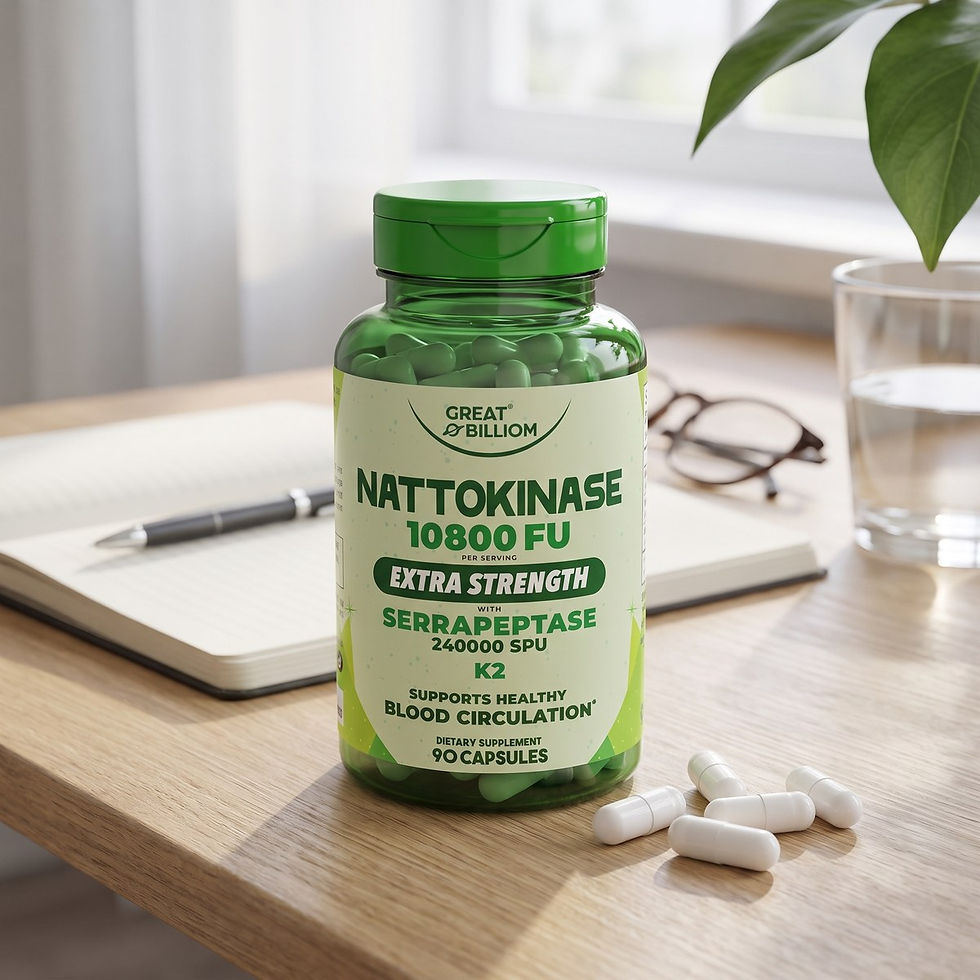
The sitting trials are about movement, and nothing in a capsule replaces the calf pump. What a nattokinase supplement adds is a different kind of support: nattokinase is a fibrinolytic enzyme from fermented soybeans, and its research base is about healthy fibrin metabolism and blood flow rather than about sitting. In a 2015 study in Scientific Reports, 12 healthy young men took a single 2,000 FU dose, and markers of fibrin breakdown rose over the following eight hours — with every change, the authors note, staying "within the normal range." That is the structure/function territory nattokinase occupies: supporting the body's normal handling of fibrin and its healthy blood flow, alongside — not instead of — the breaks above.
Great Billiom Nattokinase delivers 10,800 FU per two-capsule serving. That figure is not arbitrary: the largest nattokinase study to date, 1,062 adults followed for 12 months, used 10,800 FU per day and found its lower 3,600 FU arm ineffective — with the caveat, stated by its own authors, that it was a retrospective study rather than a randomized trial. If the FU unit is new to you, our guide to what FU means on a nattokinase label walks through it, and our comparison of natto vs nattokinase explains why the enzyme is measured that way rather than by weight. Each serving also carries 180 mcg of vitamin K2 (MK-7) and 240,000 SPU of serrapeptase in delayed-release vegetarian capsules — 90 capsules, 45 servings, $19.99, or $17.99 on Subscribe & Save. It supports healthy blood flow and circulation and leg comfort during long travel or sedentary work. Nattokinase contains soy, and anyone taking a blood thinner or antiplatelet medication, or preparing for surgery, should talk to their doctor before starting it. The travel half of that claim has its own evidence: our guide to swollen feet after flying covers what a 10-hour cabin does to your legs and what the flight trials found helps.
Key takeaways
A long sit affects the leg arteries first: after six hours, lower-leg vessel responsiveness fell by 43 percent and popliteal artery function was impaired — and a ten-minute walk restored it (Restaino 2015).
A September 2026 systematic review of 24 trials (454 adults) found the most consistent protection from two to three minutes of leg movement every 20 to 30 minutes — walking, heel raises, half-squats, stair climbing or fidgeting.
Results depend on the artery measured: leg-artery trials showed benefits; arm measurements mostly did not change.
Standing or light desk stepping for ten minutes an hour did not significantly improve popliteal function; the calves have to contract.
Nattokinase's role is different from movement: it supports healthy fibrin metabolism, blood flow and circulation, and leg comfort during sedentary work — a daily practice alongside the breaks, not a substitute for them.
Movement is the lever the trials tested, and it works within a single day. If you also want daily support for healthy blood flow and circulation through long desk days, Great Billiom Nattokinase 10,800 FU gives you the research-matched dose with K2 MK-7 and serrapeptase in one two-capsule serving, for $19.99.
Frequently asked questions
How often should you get up when sitting at a desk?
The 2026 systematic review of 24 trials found that two to three minutes of leg movement every 20 to 30 minutes was the pattern most consistently linked to protected leg blood flow and artery function. If that is not workable, one trial found an eight-minute walk every two hours held femoral blood flow when two-minute breaks did not.
Does standing up improve circulation as much as walking?
Not in the trials reviewed. Standing or light desk stepping for ten minutes an hour did not significantly improve popliteal artery function in one four-hour study, while walking, heel raises, half-squats and resistance movements did. The difference is the calf muscle pump: standing still does not contract the calves rhythmically, and walking does.
How long does it take for sitting to affect blood flow?
Within a single session. In the 2015 Experimental Physiology study, six hours of continuous sitting reduced resting shear in the lower leg, cut reactive hyperemia by 43 percent and impaired popliteal artery flow-mediated dilation. Several trials in the 2026 review measured changes after as little as three hours of sitting.
Can a nattokinase supplement replace movement breaks?
No. The sitting trials tested movement, and the calf muscle pump is what restored leg blood flow in them. Nattokinase's research is separate: it supports healthy fibrin metabolism and healthy blood flow and circulation. Great Billiom positions it as daily support alongside movement, including for leg comfort during long travel or sedentary work.
What is the research dose of nattokinase?
The largest study to date — 1,062 adults over 12 months, retrospective rather than randomized — used 10,800 FU per day and found a 3,600 FU arm ineffective. Great Billiom Nattokinase provides 10,800 FU per two-capsule serving, with 180 mcg vitamin K2 (MK-7) and 240,000 SPU serrapeptase.
Megan Elliott, Content Editor at Great Billiom. Every claim in this article is sourced from the primary research linked above. Read our editorial standards → thegreatbilliom.com/editorial-standards
Sources
He J, Xu X, Zhao Y, Cao L, Feng Z. "Effects of breaking up prolonged sitting on vascular endothelial function in adults: a systematic review." Frontiers in Cardiovascular Medicine, 2026. Published September 4, 2026. PROSPERO CRD420261332434.
Restaino RM, Holwerda SW, Credeur DP, Fadel PJ, Padilla J. "Impact of prolonged sitting on lower and upper limb micro- and macrovascular dilator function." Experimental Physiology, 2015;100(7):829–838.
Carter SE, Draijer R, Holder SM, Brown L, Thijssen DHJ, Hopkins ND. "Effect of different walking break strategies on superficial femoral artery endothelial function." Physiological Reports, 2019;7(16):e14190.
Mayo Clinic Staff. "Sitting risks: How harmful is too much sitting?" Mayo Clinic, March 26, 2025.
Kurosawa Y, Nirengi S, Homma T, Esaki K, Ohta M, Clark JF, Hamaoka T. "A single-dose of oral nattokinase potentiates thrombolysis and anti-coagulation profiles." Scientific Reports, 2015;5:11601.
Chen H, Chen J, Zhang F, et al. "Effective management of atherosclerosis progress and hyperlipidemia with nattokinase: A clinical study with 1,062 participants." Frontiers in Cardiovascular Medicine, 2022.
These statements have not been evaluated by the Food and Drug Administration. This product is not intended to diagnose, treat, cure, or prevent any disease. Individual results may vary.


Comments