Natto vs Nattokinase: Can You Just Eat Natto?

Updated: Sep 25
Natto vs nattokinase is a fair question, because one is the food and the other is a single enzyme pulled out of it — and the answer to "can I just eat natto?" is yes, with three caveats. A 50-gram pack of natto carries about 1,500 FU of nattokinase activity on average, so one or two packs a day lands near the intake the Japan NattoKinase Association recommends. But the food also delivers something a nattokinase supplement usually removes (a large dose of vitamin K2), it is more vulnerable to stomach acid than a capsule, and its enzyme content varies from pack to pack. This article lays out what the fermentation actually produces, what the numbers are, and how to decide which one belongs on your table.
In this article: What natto is — and what nattokinase is · How much nattokinase is in a pack of natto? · What fermentation adds that a capsule leaves out · What population studies say about people who eat natto · Why the food and the capsule are not interchangeable · Who should skip both until they have asked a clinician · Where Great Billiom Nattokinase 10,800 FU fits
What natto is — and what nattokinase is
Natto is whole soybeans that have been boiled and then fermented with a specific bacterium, Bacillus subtilis var. natto. The result is the sticky, pungent, brown-stringed dish that has been eaten in Japan for centuries (MSKCC, About Herbs). The Japan NattoKinase Association (JNKA) draws the line between the two terms as cleanly as anyone: natto is "a food produced by sprinkling the bacillus subtilis natto over boiled soybeans and fermenting them," while nattokinase is "an enzyme produced by the bacillus subtilis natto during the fermentation process" (JNKA FAQ).
So the bacterium is the manufacturer. As it ferments the beans it secretes enzymes to break down soy protein for its own use, and one of those enzymes turned out to have an unusual talent. In 1980, the Japanese researcher Hiroyuki Sumi, then at Chicago University Medical School, noticed that natto could break down artificial fibrin — the protein mesh that gives a blood clot its structure — in a laboratory dish. His team extracted the responsible enzyme and named it nattokinase (Weng et al., 2017). Sumi's 1987 paper, charmingly titled "A novel fibrinolytic enzyme (nattokinase) in the vegetable cheese Natto," reported that the enzyme "was easily extracted with saline" (Sumi et al., 1987, Experientia).
Chemically, nattokinase is a 275-amino-acid serine protease weighing about 27.7 kilodaltons, and its sequence is 99.3% identical to subtilisin E, a well-known bacterial enzyme — but unlike subtilisin, it shows a specific affinity for fibrin (Weng et al., 2017). A nattokinase supplement such as Great Billiom Nattokinase 10,800 FU is that one enzyme, produced by fermentation, concentrated, and standardized to a stated activity — nothing more of the food comes along with it.

How much nattokinase is in a pack of natto?
This is the number most people want, and the JNKA gives it directly: "Natto has an average of 1500 FU of nattokinase activity in a 50g serving," against a recommended daily intake of 2,000 FU, so "a simple calculation indicates that we need to consume about 1 to 2 packs of natto" (JNKA FAQ). FU means fibrinolytic units — a measure of how much fibrin the enzyme can break down in a standardized assay — and if the unit is new to you, our guide to what FU means on a nattokinase label walks through it in detail.
The word doing the heavy lifting in that quote is average. The same FAQ adds that "some natto has less nattokinase activity, some have less content in one pack, and some have less activity when they are close to their expiration date." Sumi's original measurement, in a different unit, put the activity at roughly 40 plasmin units per gram of wet natto (Sumi et al., 1987) — a figure that depends on the strain, the fermentation time, and how long the pack has sat in the refrigerator. You are eating a living food, and its enzyme content is not printed on the lid.
That is the first real difference in the natto vs nattokinase comparison. A capsule states its FU; a pack of natto gives you a probable range. If you enjoy natto and eat it most days, the range is fine. If you want to know precisely what you are taking, only the label can tell you.
What fermentation adds that a capsule leaves out
Natto is not just an enzyme carrier. Fermentation changes the beans in ways that matter nutritionally, and the headline change is vitamin K2.
Most vitamin K in a typical diet is K1 (phylloquinone) from leafy greens. Fermentation with B. subtilis produces a different form, menaquinone-7 (MK-7), in quantities found almost nowhere else in food. When Japanese researchers measured 58 foods by HPLC, MK-7 "was observed characteristically in fermented soybean products such as natto (939 µg/100 g)." For scale, raw spinach measured 498 µg/100 g of K1 and the Japanese adequate intake for young women was 60 µg per day (Kamao et al., 2007, J Nutr Sci Vitaminol). A single 50-gram pack, in other words, can supply several times a day's vitamin K on its own. The JNKA calls natto "one of the foods that contains the highest amount of vitamin K2" (JNKA FAQ).
Here is the twist: many nattokinase supplements deliberately strip that vitamin K2 out. The JNKA notes that nattokinase carrying its safety mark "is removing vitamin K2," precisely because vitamin K counteracts warfarin (JNKA FAQ). Other formulas — including ours — add a measured amount of K2 as MK-7 back in, so the label tells you exactly how much you are getting rather than leaving it to the beans. Either way, "natto vs nattokinase" is partly a question of whether you want vitamin K2 in an unmeasured food dose, a measured supplement dose, or not at all.
Fermentation has one more consequence worth knowing. Fermented foods as a group tend to be higher in histamine than their fresh counterparts, which is why natto, miso, aged cheese and cured meats appear together on most low histamine food lists. If you have noticed that fermented foods do not agree with you, that is a point in the capsule's favor — the isolated enzyme is not a fermented food.
A pack of natto (≈50 g) | A nattokinase supplement | |
Nattokinase activity | ≈1,500 FU on average; varies by brand, pack size and freshness | Stated FU per serving on the label |
Vitamin K2 (MK-7) | Very high — natto measured at 939 µg/100 g | Removed in many products; added in a measured amount in others |
Stomach acid | "Easily affected by stomach acid" (JNKA) | Capsule form is "less vulnerable" (JNKA) |
Heat | Activity "drops sharply" above 50 °C in moist conditions — do not cook it hot | Stored dry; same rule applies to storage |
Whole-food extras | Soy protein, fiber, the fermented-food matrix | None |
Histamine | Fermented food — typically higher | Not a fermented food |
Taste and texture | Strong, sticky; an acquired taste for many | Neutral |
What population studies say about people who eat natto
Two large Japanese cohorts have asked whether habitual natto eaters fare differently over time, and both are worth reading carefully — for what they found and what they cannot show.
The Takayama Study followed 13,355 men and 15,724 women aged 35 and older for 16 years after a 1992 dietary questionnaire. Participants in the highest quartile of natto intake had a 25% lower rate of cardiovascular mortality than those in the lowest quartile (hazard ratio 0.75, 95% CI 0.64–0.88), while total soy protein and isoflavones from non-natto soy foods showed no such association. The authors concluded that "natto intake may contribute to the reduction of CVD mortality" (Nagata et al., 2017, Am J Clin Nutr).
The larger Japan Public Health Center-based study tracked 92,915 adults aged 45 to 74 for 14.8 years. Total soy intake was not associated with mortality at all (HR 0.98 in both sexes). Fermented soy — natto and miso — was: the highest fifth of intake had a 10–11% lower all-cause mortality (HR 0.90 in men, 0.89 in women), and "natto showed significant and inverse associations with total cardiovascular disease related mortality in both sexes." The authors then wrote the sentence every reader should carry away: the findings "should be interpreted with caution because the significant association of fermented soy products might be attenuated by unadjusted residual confounding" (Katagiri et al., 2020, BMJ).
Two honest observations follow. First, in both studies the signal sat with fermented soy specifically, not soy in general — which is at least consistent with fermentation adding something (nattokinase, MK-7, or simply the dietary pattern of people who eat traditional foods). Second, these are observational studies of a food eaten within a whole Japanese diet. They cannot isolate the enzyme, and they say nothing about what a capsule does. Anyone who tells you a nattokinase supplement "has been shown" to do what these cohorts describe is borrowing evidence that belongs to a bowl of beans.
Why the food and the capsule are not interchangeable
Beyond the numbers, there are three practical reasons a nattokinase supplement and a pack of natto behave differently in the body and the kitchen.
Stomach acid. Nattokinase is a protein, and proteins are what stomachs digest. The JNKA states plainly that natto "is easily affected by stomach acid," whereas the enzyme in capsule form "is less vulnerable to the effects of stomach acid" (JNKA FAQ). Nattokinase appears to be unusually acid-tolerant for a protein — Weng and colleagues describe it as "more resistant to the highly acidic gastric fluids in the stomach" and able to be "absorbed in the later sections of the digestive tract," citing a 1995 rat study in which it crossed the intestinal wall intact (Weng et al., 2017) — but "unusually tolerant" is not "immune," and a delayed-release capsule exists to skip the stomach altogether. It is the same reason enzyme products across categories, from nattokinase to DAO enzyme, are formulated to protect the protein until it reaches the gut.
Heat. Enzymes denature. The JNKA gives a specific threshold: "if the temperature is above 50 °C with high moisture, the activity drops sharply," though in a dry, low-moisture state the enzyme can tolerate far more (JNKA FAQ). Natto stirred into hot rice or simmered in miso soup is delicious, but you are eating the vitamin K2 and the protein, not the full enzyme activity. A capsule kept in a cool cupboard has no such problem.
Timing and habit. The JNKA suggests taking nattokinase "between after dinner and before sleep," and notes it is "also recommended before a long flight" (JNKA FAQ). That fits a capsule far more comfortably than a pungent bowl of fermented beans at 10 p.m. — which is, frankly, the real-world reason most people outside Japan choose the supplement. If long sits are the concern rather than long flights, our digest of what 24 trials show about circulation while sitting covers what movement breaks do for leg blood flow.
Who should skip both until they have asked a clinician
The natto vs nattokinase comparison is moot for some readers. Memorial Sloan Kettering's About Herbs database warns that nattokinase "may increase the risk of bleeding" when combined with blood-thinning drugs, lists coagulation disorders and current anticoagulant use as reasons not to take it, and notes it may amplify the effect of daily aspirin. It also records severe allergic reactions in people allergic to natto itself (MSKCC, About Herbs). The vitamin K2 in natto, meanwhile, works against warfarin (JNKA FAQ). If you take any medication that affects clotting, are pregnant or nursing, or have surgery scheduled, neither the food nor the capsule is a decision to make alone.
Where Great Billiom Nattokinase 10,800 FU fits
If your answer to "can I just eat natto?" is "not every day, not at bedtime, and not without knowing the dose," this is where a standardized nattokinase supplement earns its place.
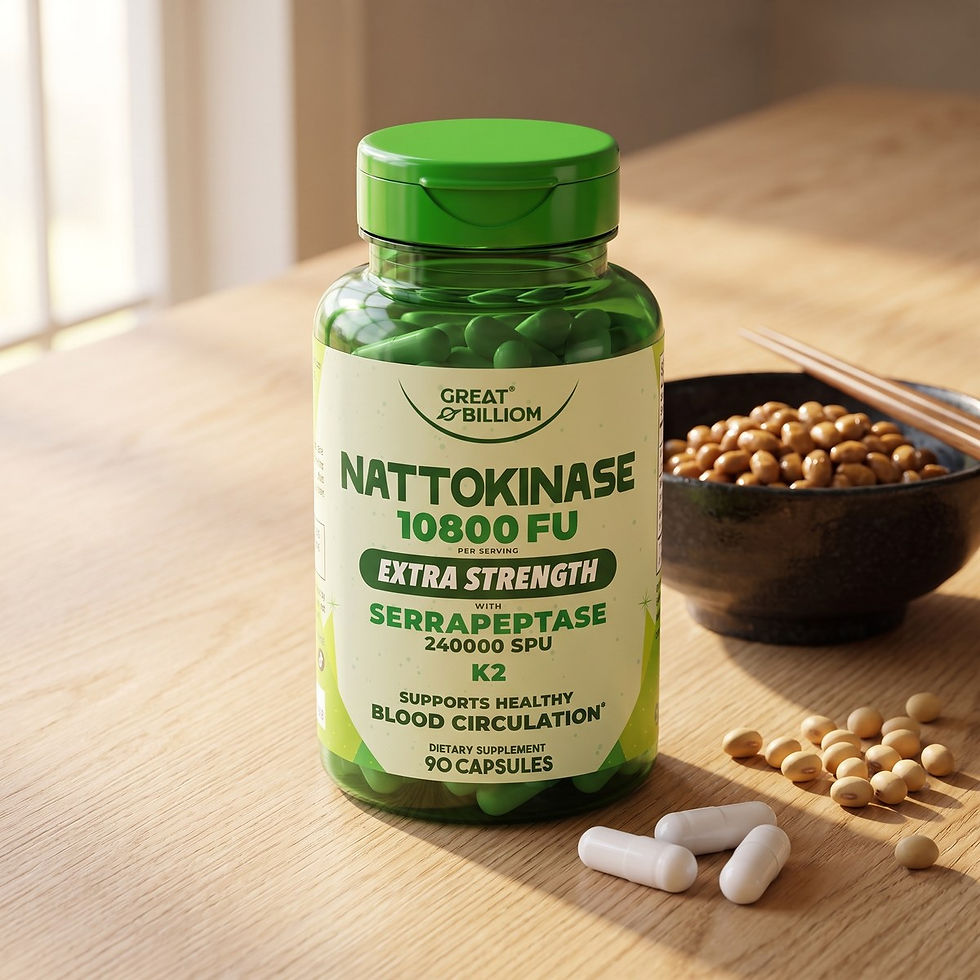
Each two-capsule serving of Great Billiom Nattokinase 10,800 FU delivers 10,800 FU of nattokinase — a stated, third-party-tested activity rather than the 1,500-FU-give-or-take of a natto pack — alongside 180 mcg of vitamin K2 as MK-7 and 240,000 SPU of serrapeptase. The capsules are delayed-release vegetarian HPMC, designed to carry the enzyme past the stomach, and there are 90 per bottle for 45 servings. Because it is made from fermented soybeans it contains soy, and it is vegetarian rather than vegan. It is $19.99 per bottle, or $17.99 with Subscribe & Save.
In structure/function terms, the formula supports healthy blood flow and circulation, healthy fibrin metabolism, and cardiovascular wellness as part of an active lifestyle for adults 40 and over, while the K2 MK-7 supports calcium delivery to bones and teeth.* It is not a replacement for any medication, and it is not for anyone on anticoagulant or antiplatelet therapy without a clinician's agreement. Suggested use is two capsules daily on an empty stomach, at least one hour before or two hours after a meal.
Key takeaways
Natto is the food; nattokinase is one enzyme that Bacillus subtilis natto produces while fermenting the soybeans.
A 50 g pack of natto averages about 1,500 FU of nattokinase activity, but the figure varies with brand, pack size and freshness, and it is not on the label.
Fermentation makes natto one of the richest food sources of vitamin K2 (MK-7), at 939 µg/100 g — a dose many nattokinase supplements remove and some add back in a measured amount.
Two large Japanese cohorts link habitual natto eating with lower cardiovascular mortality — observational findings about a food, not evidence about a capsule.
Natto is more vulnerable to stomach acid and heat than a delayed-release capsule, and it is higher in histamine as a fermented food.
If you love natto, keep eating it — the evidence for the food is real, if observational. If you want the enzyme without the taste, the timing problem, or the guesswork, the Great Billiom Nattokinase 10,800 FU page lists every figure discussed here — FU per serving, K2 MK-7 content, serrapeptase, capsule type and third-party testing — in one place, and ships within the USA.
Frequently asked questions
Is natto the same as nattokinase?
No. Natto is the whole fermented-soybean food; nattokinase is a single enzyme that the fermenting bacterium, Bacillus subtilis natto, produces inside it. A nattokinase supplement contains that one enzyme, concentrated and standardized to a stated activity in FU, without the soy protein, fiber or vitamin K2 that come with the food.
How much natto equals a nattokinase supplement?
The Japan NattoKinase Association puts the average pack (50 g) at about 1,500 FU and recommends 2,000 FU a day, so roughly one to two packs. The enzyme content varies by brand and freshness, though, and supplements range from 2,000 FU to 10,800 FU per serving — check the label's FU per serving rather than assuming equivalence.
Does natto have vitamin K2?
Yes, and unusually much of it. Fermentation with Bacillus subtilis produces menaquinone-7 (MK-7); one HPLC survey measured 939 µg per 100 g of natto, far above the Japanese adequate intake of 60 µg a day. Many nattokinase supplements remove vitamin K2; others, including Great Billiom's, add a measured amount of MK-7 back in.
Can I eat natto if I take warfarin?
Ask your prescriber first. The vitamin K2 in natto counteracts warfarin, which is the reason the Japan NattoKinase Association itself flags natto for warfarin users. Memorial Sloan Kettering also advises against nattokinase for anyone on anticoagulant medication or daily aspirin, so neither the food nor the supplement is a solo decision here.
Does cooking natto destroy nattokinase?
Largely, yes, if it gets hot and wet. The Japan NattoKinase Association reports that nattokinase activity "drops sharply" above 50 °C in high-moisture conditions. Natto eaten cold or at room temperature keeps its enzyme; natto simmered in soup keeps its protein and vitamin K2 but loses much of the enzyme activity.
Megan Elliott, Content Editor at Great Billiom. Every claim in this article is sourced from the primary research linked above. Read our editorial standards → thegreatbilliom.com/editorial-standards
Sources
Japan NattoKinase Association. Nattokinase FAQ. https://j-nattokinase.org/en/faq/
Sumi H, Hamada H, Tsushima H, Mihara H. A novel fibrinolytic enzyme (nattokinase) in the vegetable cheese Natto; a typical and popular soybean food in the Japanese diet. Experientia. 1987;43(10):1110–1111. https://pubmed.ncbi.nlm.nih.gov/3478223/
Weng Y, Yao J, Sparks S, Wang KY. Nattokinase: An Oral Antithrombotic Agent for the Prevention of Cardiovascular Disease. Int J Mol Sci. 2017;18(3):523. https://www.mdpi.com/1422-0067/18/3/523
Kamao M, Suhara Y, Tsugawa N, et al. Vitamin K content of foods and dietary vitamin K intake in Japanese young women. J Nutr Sci Vitaminol (Tokyo). 2007;53(6):464–470. https://pubmed.ncbi.nlm.nih.gov/18202532/
Nagata C, Wada K, Tamura T, et al. Dietary soy and natto intake and cardiovascular disease mortality in Japanese adults: the Takayama study. Am J Clin Nutr. 2017;105(2):426–431. https://pubmed.ncbi.nlm.nih.gov/27927636/
Katagiri R, Sawada N, Goto A, et al. Association of soy and fermented soy product intake with total and cause specific mortality: prospective cohort study. BMJ. 2020;368:m34. https://www.bmj.com/content/368/bmj.m34
Memorial Sloan Kettering Cancer Center. About Herbs: Nattokinase. https://www.mskcc.org/cancer-care/integrative-medicine/herbs/nattokinase
*These statements have not been evaluated by the Food and Drug Administration. This product is not intended to diagnose, treat, cure, or prevent any disease. Individual results may vary. This article is for educational purposes and is not medical advice; consult a qualified healthcare professional before starting any supplement, especially if you take medication or have a medical condition.


Comments