Exercise and Histamine: Why You Get Itchy

Ten minutes into a run, your legs start to prickle. Your face is flushed, your skin is warm, and if you stop to look there may be a few raised bumps on your neck. The usual explanation is "histamine," and it is correct — but not in the way most people mean it. Working muscle makes its own histamine, on purpose, from immune cells that live inside it. It rises while you move, falls when you stop, and when researchers block it, recovery slows and training stops paying off. This is the body's histamine, not the histamine on your plate, which is a different pool with a different enzyme. If the post-workout meal is where you want support, that is what a DAO enzyme supplement is for. Here is what the research shows about each.
In this article: The itch has a mechanism, and it is usually a mild one · Working muscle makes its own histamine · Block it, and recovery stalls · Block it for six weeks, and training stops paying · Three pools, one word · When the itch is a doctor question · Where Great Billiom DAO Enzyme fits
The itch has a mechanism, and it is usually a mild one
Start with the skin, because that is where you notice it. The Cleveland Clinic describes the common version plainly: hives "that appear when your body temperature rises and you start to sweat." Exercise is the trigger for nearly nine in ten people who get them, alongside hot showers, hot rooms, strong emotion and spicy food. They tend to show up "a few minutes after you start sweating" and "may last for 20 to 30 minutes." A 2016 case report in American Family Physician gives the same timing: lesions appear "approximately five to 10 minutes after an inciting event, such as eating spicy foods, exercise, feeling intense emotions, or bathing in hot water," and most resolve within 15 to 20 minutes.
Two things are worth knowing about that picture. First, the Cleveland Clinic's explanation runs through the nervous system — a rising body temperature leads to acetylcholine release near the skin, which sets the reaction off — not through a surge of histamine from anywhere else. Histamine is involved at the skin itself; the American Family Physician authors note that the welts raised by pressure on the skin are "the result of histamine release when pressure is applied to the skin." Second, for most people this is a brief, self-limiting event that arrives with the warm-up and leaves with the cool-down. It is not an allergy to exercise, and it is not a sign that something in you is broken.
What it is, as the next few decades of exercise physiology have shown, is one visible edge of a much larger process.
Working muscle makes its own histamine
In April 2025, a group led by Van der Stede published a cellular map of human skeletal muscle during exercise in Cell Metabolism. Using single-cell data from muscle biopsies, they found that the muscle fibers themselves respond to a workout more modestly than expected, and that much of the response comes from the other cells living between them. Among those cells was a mast cell population "likely responsible for histamine secretion during exercise." Mast cells are the immune cells that store histamine; these ones also carried the enzyme that makes it, which led the authors to conclude that "mast cells are probably the unique histamine producers in human skeletal muscle."
They measured it directly. Using microdialysis probes in the thigh during 30 minutes of one-legged knee-extension exercise, they confirmed that histamine rises in the fluid between muscle cells during active exercise and, in the authors' words, returned to baseline once the exercise stopped. In other words, this is not a stored load being dumped. It is a signal switched on by movement and switched off by rest.
The signal is aimed at specific targets. H1 receptors were enriched on immune cells in the muscle, H2 receptors on immune cells and the smooth muscle of blood vessels, and the authors summarize the result as mast cells "triggering activation of H1 and H2 receptors on myeloid and vascular cells" — the clean-up crew and the plumbing, rather than the muscle fibers themselves. That fits what the University of Oregon's John Halliwill had reported nearly a decade earlier: naturally occurring histamine in the body relaxes blood vessels, increasing circulation that supports recovery after a workout. The warmth and flush you feel after exercise is, in part, that dilation. That lingering dilation is also half of why stopping dead after a run can leave you light-headed; our article on whether you need to cool down after exercise covers the other half — the muscle pump switching off.
Block it, and recovery stalls
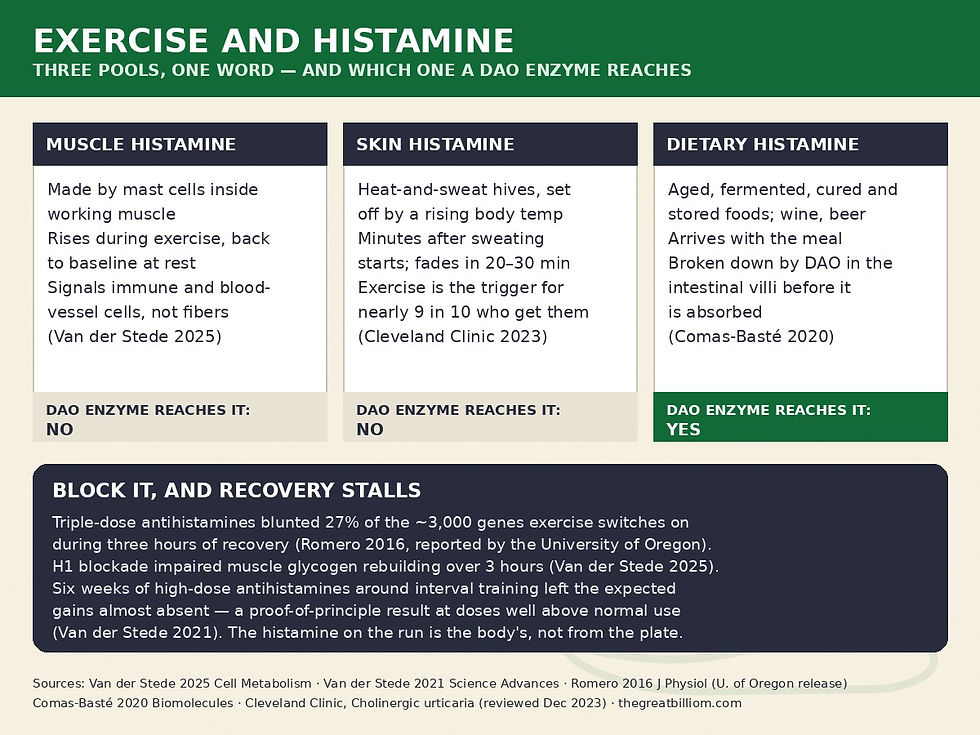
The cleanest way to find out what a signal does is to block it and watch what fails. In 2016, Halliwill's group had sixteen fit young adults perform an hour of knee-extension exercise; eight of them first took nearly triple the recommended doses of two antihistamines, fexofenadine and ranitidine. Over the three-hour recovery period, roughly 795 of about 3,000 genes that exercise normally switches on — 27 percent — showed a blunted response in the antihistamine group. Steven Romero, the doctoral student who led the work, put it this way: "Histamine, a substance that we typically think of negatively … is an important substance contributing to the normal day-to-day response to exercise."
The 2025 Cell Metabolism study extended that to fuel. After exercise, muscle rebuilds its glycogen stores over the following hours. The authors blocked H1 or H2 receptors in volunteers and found that "the resynthesis of glycogen during the 3-h recovery window, however, was impaired with H1 receptor blockade but not with H2 receptor blockade." Their highlight line is blunt: histamine receptor antagonists "impair post-exercise muscle glycogen resynthesis." The signal that makes your skin prickle is also part of how your muscle restocks.
Block it for six weeks, and training stops paying
The most striking experiment is the one that ran longest. In a 2021 study in Science Advances, Van der Stede's group gave healthy, untrained young men either a placebo or high doses of two antihistamines around every session of a six-week interval-cycling program. The 2025 paper summarizes the result: the histamine signaling system "plays an essential role in driving the adaptive chronic response (aerobic capacity, insulin sensitivity, and microvascular function) to exercise training in humans." A summary prepared for Denmark's national sports organization reports the design in more detail — 540 mg of fexofenadine plus 40 mg of famotidine before and after each session, three sessions a week — and the outcome: the placebo group gained the expected improvements in insulin sensitivity, vascular function, capillary density and maximal oxygen uptake, while the antihistamine group showed almost no improvement on the identical program.
Two cautions belong next to that result, and the authors state them. The doses were high relative to normal use, and the study was a proof of principle: it does not show what a normal allergy-pill dose does to a normal training week. Halliwill, asked the same question after his 2016 study, said the evidence was not enough to tell exercisers to avoid antihistamines, because the body has redundancies that may compensate. If you take an antihistamine for a reason, this is a conversation with your doctor, not a reason to stop.
Three pools, one word
The reason all of this gets tangled is that "histamine" names one molecule in three different places, handled by different enzymes.
Pool | Where it comes from | When it rises | What handles it | Does a DAO enzyme supplement reach it? |
Muscle histamine | Mast cells inside working muscle (Van der Stede 2025) | During exercise; back to baseline at rest | HNMT inside cells; receptors on immune and vessel cells | No — it never passes through the gut |
Skin histamine | Mast cells in the skin, with heat and sweat as triggers (Cleveland Clinic) | Minutes after sweating starts; 20–30 minutes | The same tissue enzymes | No — released inside the body, not swallowed |
Dietary histamine | Aged, fermented, cured and stored foods; wine and beer (Comas-Basté 2020) | Whenever the meal is | DAO in the intestinal villi | Yes — that is its job |
The 2020 review in Biomolecules by Comas-Basté and colleagues draws the boundary. Histamine inside the body "is synthesized and stored in high concentrations in secretory granules, mainly in basophils and mast cells," and when those cells release it, a second enzyme, HNMT, is "responsible for the inactivation of intracellular histamine." Diamine oxidase is a different enzyme in a different place: its activity "increases progressively from the duodenum to the ileum and is located mainly in the intestinal villi," where it "plays the major role in protecting the body against exogenous histamine, whether originating from ingested food or generated by the intestinal microbiota."
So the histamine your muscle makes on a run is not what a DAO supplement works on. It is released inside tissue, it does its job on the cells next door, and it is cleared there. We covered the same boundary for the nighttime version in our article on the histamine dump at night — brain, immune and dietary pools, each on its own clock — and it holds on the track as well as in bed.
When the itch is a doctor question
Mild prickling that arrives with the warm-up and fades with the cool-down is the common pattern. A few things fall outside it. The Cleveland Clinic lists shortness of breath or difficulty breathing, and any signs of anaphylaxis, as reasons to seek care immediately. Hives that last well over an hour, swelling of the lips or throat, dizziness or a drop in blood pressure around exercise, or a reaction that only ever happens when you have eaten a particular food beforehand are patterns a doctor should hear about, because they are a different mechanism from the one described above. The physiology in this article is about healthy adults in a laboratory; it is not a way to sort your own symptoms.
Where Great Billiom DAO Enzyme fits

If you think about histamine the way we do — as a bucket that fills from several taps and overflows as symptoms — a training day is a day when one of the body's own taps runs for a while. You cannot turn that tap off, and the research above says you would not want to. The Bucket Check asks a different question: what else is going into the bucket today, and how fast is the drain running?
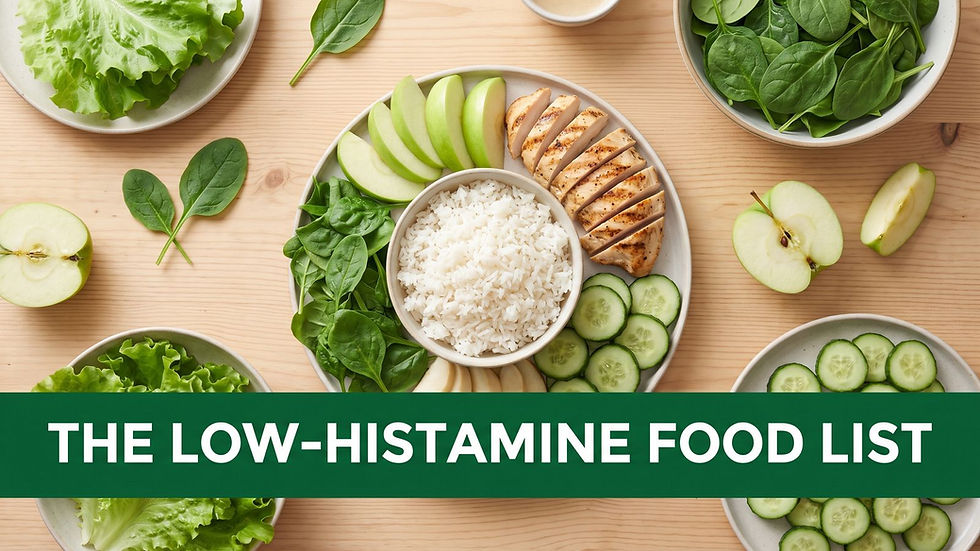
The tap you control is the meal after. Post-workout plates lean on exactly the foods that carry the most dietary histamine — cured meats, aged cheese, canned fish, fermented sides, a recovery beer, and the leftovers you cooked on Sunday. Our low histamine diet food list walks through which ones carry the most. That is the pool a DAO enzyme supplement is for. Diamine oxidase is the enzyme your intestinal lining uses to break down histamine from food and drink before it is absorbed. Taken before a meal, supplemental DAO supports that breakdown in the gut, where the food is. It does not reach the histamine your mast cells release on a run, and no supplement does.
Great Billiom DAO Enzyme delivers 30,000 HDU of diamine oxidase per capsule. The serving is one capsule, taken 10 to 15 minutes before a meal; a bottle holds 60 — a two-month supply — for $19.99, or $17.99 on Subscribe & Save, which works out to $0.33 per capsule. It supports dietary histamine metabolism and breakdown, and it supports food tolerance. Our guide to how the DAO enzyme works covers timing and label reading in detail. If you take any medication, including an antihistamine, talk to your doctor before adding a supplement.
Key takeaways
The itch and flush of exercise usually come from heat-and-sweat hives that start minutes after sweating begins and fade within 20 to 30 minutes (Cleveland Clinic; American Family Physician 2016).
Working muscle contains its own mast cells, which release histamine during exercise; the level returns to baseline once exercise stops (Van der Stede 2025, Cell Metabolism).
That histamine signals immune and blood-vessel cells, not muscle fibers. Blocking H1 receptors impaired glycogen rebuilding over three hours of recovery, and triple-dose antihistamines blunted 27 percent of the genes exercise normally switches on (Romero 2016, as reported by the University of Oregon).
Six weeks of high-dose antihistamines around interval training left the expected gains in aerobic capacity, insulin sensitivity and microvascular function almost absent — a proof-of-principle result at doses well above normal use (Van der Stede 2021).
The histamine your body makes is cleared inside tissue by HNMT; the histamine you eat is broken down by DAO in the intestinal villi. Only the dietary pool is what a DAO enzyme supplement acts on (Comas-Basté 2020).
The histamine on the run is the body's; the plate afterward is yours. If exercise ever brings on breathing trouble or swelling, that is a doctor question first. If the post-workout meal is the part of The Bucket Check you want support with, our DAO Enzyme is 30,000 HDU per capsule, 60 capsules, $19.99.
Frequently asked questions
Why does my skin itch when I exercise?
For most people it is heat-and-sweat hives: raised bumps that appear a few minutes after sweating starts and usually fade within 20 to 30 minutes, according to the Cleveland Clinic. A rising body temperature leads to acetylcholine release near the skin, and histamine is released at the skin itself. It is common, brief and not an allergy to exercise.
Does exercise release histamine?
Yes. A 2025 study in Cell Metabolism found a population of mast cells inside human muscle that releases histamine during exercise. Measured in the fluid between muscle cells, histamine rose during active knee-extension exercise and returned to baseline once the exercise stopped. The signal targets immune and blood-vessel cells in the muscle rather than the muscle fibers.
Do antihistamines affect exercise recovery?
In research settings, yes. Triple-dose antihistamines blunted about 27 percent of the genes exercise switches on during three hours of recovery, and H1 blockade impaired muscle glycogen rebuilding. Six weeks of high doses around interval training left most adaptations absent. The doses were well above normal use, and the authors call for caution; ask your doctor before changing any medication.
Is histamine from exercise the same as histamine from food?
Same molecule, different pool. Exercise histamine is made by mast cells inside your tissues and cleared there by the enzyme HNMT. Dietary histamine arrives with aged, fermented, cured and stored foods, wine and beer, and is broken down by diamine oxidase in the intestinal lining. The two never meet, and they are handled by different enzymes.
Where does a DAO enzyme supplement fit on a training day?
At the meal, not the workout. A DAO enzyme supplement supports the breakdown of histamine that arrives with food, in the gut, before it is absorbed. It does not act on the histamine your muscle releases while you exercise. In Bucket Check terms, the training tap runs on its own; the post-workout plate is the one you control.
Megan Elliott, Content Editor at Great Billiom. Every claim in this article is sourced from the primary research linked above. Read our editorial standards → thegreatbilliom.com/editorial-standards
Sources
Van der Stede T, Van de Loock A, Turiel G, et al. "Cellular deconstruction of the human skeletal muscle microenvironment identifies an exercise-induced histaminergic crosstalk." Cell Metabolism, 2025;37:842–856.
Van der Stede T, et al. "Histamine H1 and H2 receptors are essential transducers of the integrative exercise training response in humans." Science Advances, 2021;7(16):eabf2856. Reported here as summarized in Van der Stede 2025 and in a Team Danmark research summary.
University of Oregon. "Should exercisers lay off the antihistamines?" News release on Romero SA, Dreyer HC, Halliwill JR et al., Journal of Physiology, 2016. April 14, 2016.
Romero SA. "Sustained Post-exercise Vasodilation: Histaminergic Mechanisms and Adaptations." Doctoral dissertation, University of Oregon, 2015.
Comas-Basté O, Sánchez-Pérez S, Veciana-Nogués MT, Latorre-Moratalla M, Vidal-Carou MC. "Histamine Intolerance: The Current State of the Art." Biomolecules, 2020;10(8):1181.
Cleveland Clinic. "Cholinergic Urticaria: What It Is, Causes, Symptoms & Treatment." Last reviewed December 29, 2023.
Larson SL, Uwagbai ON. "An Activity-Induced Rash." American Family Physician, 2016;94(9):735–736.
These statements have not been evaluated by the Food and Drug Administration. This product is not intended to diagnose, treat, cure, or prevent any disease. Individual results may vary.


Comments