Histamine Dump at Night: What's Actually Real

A "histamine dump" is the wellness-world name for the 2 a.m. wake-up with a racing heart, itchy skin or a stuffy nose that seems to arrive out of nowhere. You will not find the phrase in a medical textbook or a peer-reviewed paper — it is a social-media term, not a clinical one. But the pattern people describe is not imaginary. Histamine in the body does keep a daily rhythm, and part of that rhythm really does turn upward at night. The catch is that the word "histamine" covers three different pools that behave in three different ways, and the story usually mixes them up. Here is what the research shows about each, and where the histamine on your dinner plate fits.
In this article: What people mean by "histamine dump" · The rhythm that is real: immune cells keep time · The rhythm that runs the other way: brain histamine · Three pools, one word · Why a late dinner still matters · Where Great Billiom DAO Enzyme fits
What people mean by "histamine dump"
Search the phrase and you get a consistent picture: symptoms that cluster between midnight and dawn — flushing, itching, hives, congestion, a pounding heart, sudden wakefulness — explained as the body "dumping" a stored load of histamine all at once. The usual advice follows from that picture: eat earlier, avoid high-histamine foods in the evening, and take an antihistamine or a DAO enzyme supplement before bed.
Some of that holds up. Some of it does not. To sort it, you have to separate the three places histamine comes from, because a gut enzyme, a mast cell and a brain neuron each run on a different clock.
The rhythm that is real: immune cells keep time
The strongest evidence behind the nighttime story comes from immunology, not from wellness blogs. A 2018 review in Frontiers in Immunology by Lorentz and colleagues lays out how mast cells — the immune cells that store and release histamine — carry their own molecular clock. Core clock genes such as Per1, Per2, Bmal1 and Clock cycle inside mast cells over 24 hours, and the CLOCK protein binds directly to the promoters of mast-cell genes, gating when those cells are most ready to fire.
The clinical pattern lines up with that. As the review puts it, "allergic conditions such as asthma or allergic rhinitis have historically shown circadian bias as the severity of symptoms is exacerbated between midnight and morning time." It also reports that in people with mastocytosis — a condition of excess mast cells — "peak levels of plasma histamine were observed in the early morning with the lowest in the afternoon." Two cautions belong next to that finding. It comes from mastocytosis patients, not from healthy adults or from people who suspect histamine intolerance. And the most direct experiment on the clock mechanism was done in mice: animals with a broken Per2 gene lost the time-of-day difference in their skin reactions.
Cortisol is the other half of the explanation. The review notes that "plasma concentrations of adrenocorticotrophic hormone and cortisol show circadian variations in humans," and that when corticosterone (the mouse equivalent) was high by day, Per2 expression in mast cells was high too. Cortisol restrains inflammation, and its daily low arrives in the early hours of the night. Put the mast-cell clock and the cortisol trough together and you have a real, documented reason that allergic-type symptoms cluster before dawn. Nothing about it requires a stored "load" being dumped; it is a rhythm, running every night, that most people never notice.
The rhythm that runs the other way: brain histamine
Here is where the popular story breaks. The histamine that keeps you awake is made by a cluster of neurons in the tuberomammillary nucleus of the hypothalamus, and it follows the opposite schedule. A 2019 review in the journal Sleep by Scammell and colleagues describes it plainly: these "histamine neurons fire fastest during wake, especially active wake, and extracellular histamine levels are highest during the active period." During deep sleep they "fire little," and in REM sleep "they are essentially silent."
That is why old-fashioned allergy pills make people drowsy. Diphenhydramine and doxylamine "penetrate the brain well," the review notes, and block the H1 receptors that histamine uses to hold the brain awake. Brain histamine is a daytime chemical. If a "histamine dump" were literally a surge of histamine in the brain, it would be happening at breakfast, not at 2 a.m.
So the two rhythms point in different directions: immune-cell histamine is more active at night, brain histamine is less. The 2 a.m. wake-up, if histamine is involved at all, is more likely the downstream effect of an allergic-type reaction — itch, congestion, a racing heart — than a direct hit of histamine on the sleep-wake switch.
Three pools, one word
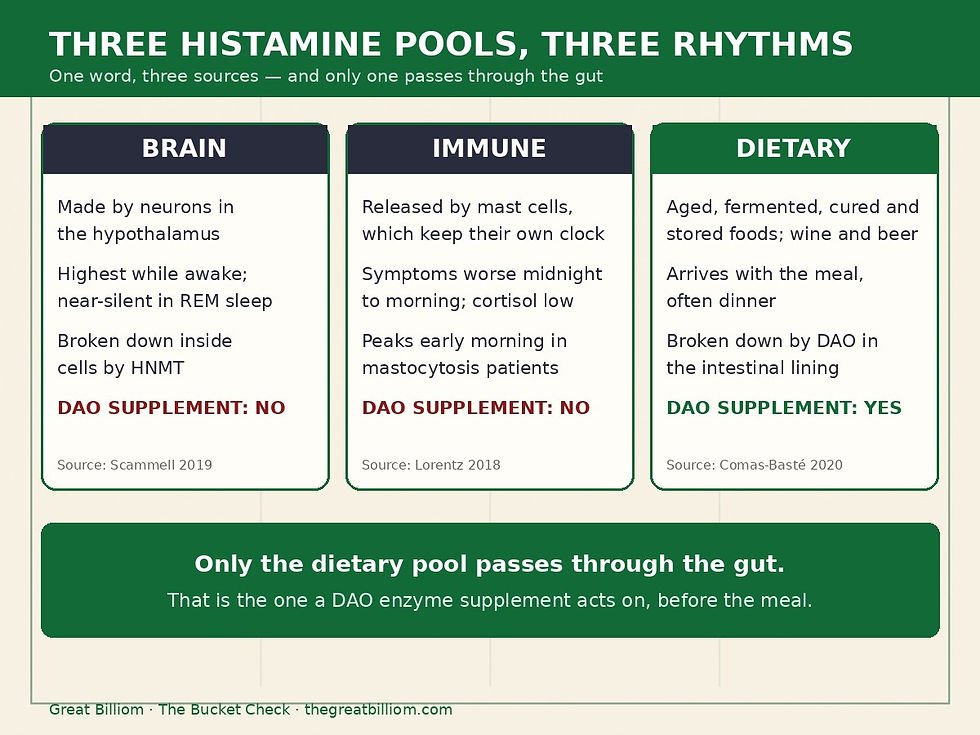
Pool | Where it comes from | When it peaks | What breaks it down | Does a DAO enzyme supplement reach it? |
Brain histamine | Neurons in the tuberomammillary nucleus | Waking hours; near-silent in REM sleep (Scammell 2019) | HNMT, inside cells | No — it never meets the gut |
Immune histamine | Mast cells and basophils, clock-gated | Night to early morning in mastocytosis patients (Lorentz 2018) | HNMT and DAO in tissue | No — released inside the body, not swallowed |
Dietary histamine | Aged, fermented, cured and stored foods; wine and beer | Whenever the meal is — often dinner | DAO in the intestinal lining (Comas-Basté 2020) | Yes — that is its job |
The 2020 Biomolecules review by Comas-Basté and colleagues draws the line clearly: diamine oxidase "is responsible for the degradation of extracellular histamine" arriving from food, while a second enzyme, HNMT, "is responsible for the inactivation of intracellular histamine." DAO is made mainly in the intestine, its activity "increases progressively from the duodenum to the ileum," and its role is to be "the main barrier against exogenous histamine in the intestines." Schnedl and Enko, writing in Nutrients in 2021, locate it precisely: "DAO activity ... is located in the intestinal villi," where it is "the primary enzyme responsible for degrading ingested ... histamine."
That geography matters for the nighttime question. A histamine pool that is released by your own cells, inside your own tissues, is not something an enzyme sitting in your gut can reach. The dietary pool is.
Why a late dinner still matters
If you think about histamine the way we do — as a bucket filling from several taps at once, with symptoms when it overflows — the nighttime picture is a timing problem. The Bucket Check says: what is going into the bucket in the hours before bed, and how fast is the drain running?
The evening meal is the tap you control. Aged cheese, cured meats, fermented foods, canned fish, wine and beer are the foods that carry the most histamine, and they are disproportionately dinner foods. So are leftovers, which is why our low histamine diet food list lists them as a hidden source. A dietary histamine load taken on at 8 p.m. is arriving in the gut during the same hours when mast cells are most primed and cortisol is at its low. The bucket is being filled from two taps at once.
Two honest limits belong here. First, histamine intolerance itself is estimated by the Biomolecules review to affect "1–3% of the population," and the Cleveland Clinic notes that "a 2023 study ruled out histamine intolerance in most people who thought it was causing their symptoms." Night waking, a racing heart and flushing have many causes, and a bucket model is an educational picture, not a test. Second, the gut-based complaints are the ones most consistently tied to dietary histamine: Schnedl and Enko report bloating in more than 90% of patients and post-meal fullness or diarrhea in more than 70%. If your nighttime symptoms are mostly skin, airway or heart and do not track what you ate, the immune-cell rhythm above is the more likely explanation, and that is a conversation for a doctor — our overview of histamine intolerance symptoms and causes covers how clinicians think about it.
There is one more evening variable. Alcohol is both a histamine source and, per the same 2020 review, one of the substances that can temporarily reduce DAO activity — it adds to the bucket and slows the drain. If a glass of red is part of the late-dinner pattern, our piece on the red wine headache walks through what red wine does and does not carry.
Where Great Billiom DAO Enzyme fits

Of the three histamine pools, only one passes through your gut, and it is the one that arrives with dinner. That is what a DAO enzyme supplement is for. Diamine oxidase is the enzyme your intestinal lining uses to break down histamine from food and drink before it is absorbed — the Biomolecules review describes its "significant barrier effect against the absorption of exogenous histamine into the systemic circulation." Taken before a meal, supplemental DAO supports that breakdown in the gut, where the food is. It does not reach histamine that your mast cells release or that your brain makes; no supplement does, and any product that says otherwise is describing a pool it cannot touch.
The 2026 review in Nutraceuticals by Manteigas and colleagues sums up the state of the research fairly: DAO supplements are "safe and well tolerated, with no significant reports of adverse effects," and "the current scientific evidence is still limited." We would rather you read that sentence here than discover it later.
Great Billiom DAO Enzyme delivers 30,000 HDU of diamine oxidase per capsule. The serving is one capsule, a bottle holds 60 — a two-month supply — for $19.99, or $17.99 on Subscribe & Save, which works out to $0.33 per capsule. It supports dietary histamine metabolism and breakdown, and it supports food tolerance, which for most people means the aged-cheese-and-wine dinners that make an evening worth having. Our guide to how the DAO enzyme works covers timing and label reading in detail.
Key takeaways
"Histamine dump" is a social-media term, not a clinical one — but the nighttime pattern it describes has a documented basis in the daily rhythm of immune cells.
Mast cells carry their own molecular clock; allergic-type symptoms are known to worsen between midnight and morning, and cortisol, which restrains inflammation, is at its daily low in those hours (Lorentz 2018).
Brain histamine runs the opposite way: the neurons that make it fire fastest while you are awake and go nearly silent in REM sleep (Scammell 2019). A nighttime "surge" in the brain is not what the evidence shows.
Only one histamine pool passes through the gut — the dietary one — and it is the only pool a DAO enzyme supplement acts on.
The evening meal is the tap you control: aged, fermented, cured and stored foods, wine and beer add dietary histamine at the hour the body's own release is rising.
The nighttime rhythm is the body's; the dinner is yours. If the evening meal is the part of The Bucket Check you want support with, our DAO Enzyme is 30,000 HDU per capsule, 60 capsules, $19.99. If night waking, flushing or a racing heart is a regular event, bring the pattern to your doctor as well — those symptoms have many causes, and dietary histamine is only one.
Frequently asked questions
Is a histamine dump a real medical condition?
No. "Histamine dump" is a popular term, not a clinical one, and it does not appear in the research literature. The pattern it describes — allergic-type symptoms clustering between midnight and morning — is real and documented, and it is explained by the daily rhythm of mast cells and cortisol rather than by a stored load being released all at once.
Why is histamine higher at night?
Immune histamine follows a daily clock. Mast cells carry their own circadian genes, and a 2018 review in Frontiers in Immunology reports that allergic symptoms worsen between midnight and morning, with plasma histamine peaking in the early hours in mastocytosis patients. Cortisol, which restrains inflammation, is at its daily low at the same time.
Does a histamine dump wake you up?
Not in the way the phrase suggests. The histamine that keeps the brain awake is made by neurons that are most active during the day and nearly silent in REM sleep, according to a 2019 review in Sleep. Night waking, if histamine is involved, is more likely a downstream effect of an allergic-type reaction such as itch, congestion or a racing heart.
Does eating late cause a histamine dump?
Eating late does not create the nighttime rhythm, but it can add to it. Aged cheese, cured meats, fermented foods, leftovers, wine and beer carry the most dietary histamine, and a late dinner delivers that load during the hours when the body's own histamine release is rising. In Bucket Check terms, two taps are running at once.
Where does a DAO enzyme supplement fit at night?
A DAO enzyme supplement acts in the gut, on histamine that arrives with food and drink, and supports its breakdown before it is absorbed. It does not act on histamine released by mast cells or made in the brain. Its place is before the evening meal, on the dietary part of the picture; for symptoms that keep recurring at night, talk to your doctor.
Megan Elliott, Content Editor at Great Billiom. Every claim in this article is sourced from the primary research linked above. Read our editorial standards → thegreatbilliom.com/editorial-standards
Sources
Lorentz A, Christ P, Sowa AS, Froy O. "The circadian clock drives mast cell functions in allergic reactions." Frontiers in Immunology, 2018;9:1526.
Scammell TE, Jackson AC, Franks NP, Wisden W, Dauvilliers Y. "Histamine: neural circuits and new medications." Sleep, 2019;42(1):zsy183.
Comas-Basté O, Sánchez-Pérez S, Veciana-Nogués MT, Latorre-Moratalla M, Vidal-Carou MC. "Histamine Intolerance: The Current State of the Art." Biomolecules, 2020;10(8):1181.
Schnedl WJ, Enko D. "Histamine Intolerance Originates in the Gut." Nutrients, 2021;13(4):1262.
Manteigas B, Ferreira M, Ribeiro R, Silva R, Campos MJ, Real H, Ramos F. "Histamine Intolerance: Mechanisms, Dietary Approaches, Microbiota Modulation, and Supplementation Strategies." Nutraceuticals, 2026;6(3):46.
Cleveland Clinic. "Histamine Intolerance: Causes, Symptoms & Treatment." Last reviewed August 27, 2024.
These statements have not been evaluated by the Food and Drug Administration. This product is not intended to diagnose, treat, cure, or prevent any disease. Individual results may vary.


Comments